Publisher’s Commentary

Undoubtedly safety remains at the core of aviation and sits up there at the fulcrum of the wheel of air transport, so every investment made to ensure safety of air transport is money well spent.
While we commend the industry for the appreciable improvements to air safety across the world over the past years, we applaud particularly the decision of the three leading aviation industry bodies, the International Air Transport Association – IATA, the Civil Air Navigation Services Organisation – CANSO and the Airports Council International – ACI to launch a joint initiative to reduce the risk of runway incursions in global aviation termed Joint Runway Safety Initiative. These collaborative frameworks have contributed in no small measure to the improvements witnessed in air safety across the world and Africa, in particular.
However, safety is not enough if air travel remains out of reach of many ordinary citizens. Therefore, in July 2026 at the 69th meeting of the Authority of the Economic Community of West African States (ECOWAS) in Sierra Leone, the Heads of State reaffirmed their earlier commitment to reduce the cost of air transportation in the subregion and drive affordability.
To give effect to this commitment, and in response to identified impediments as states work to implement the directive, the Heads of State further mandated states to “expedite national processes including notably cross-sectoral consultations, revision of related tax laws, sensitization of stakeholders and airport service providers, and comply with Authority Decision on taxes on air transport and reduction of passenger service and security charges”.
We are also heartened by the Heads of State’s call on the ECOWAS Bank for Investment and Development, the African Development Bank, the Afrexim Bank and other development partners to collaborate with the ECOWAS Commission to raise funding to support air transport infrastructure and services. Whereas aviation infrastructure improvements are visible across the continent, the need for more investments in critical infrastructure cannot be overlooked.
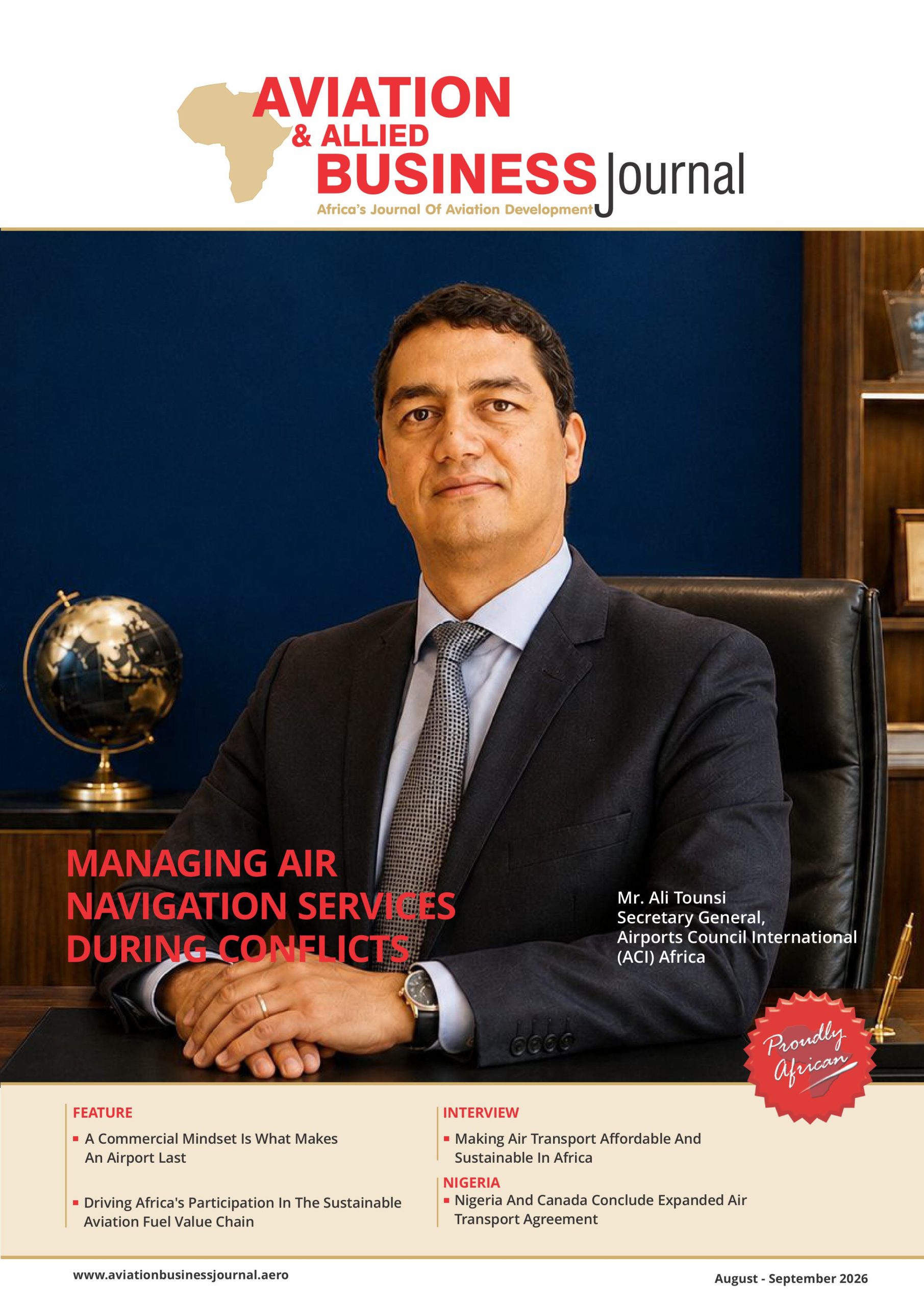
The August-September 2026 edition of the Aviation & Allied Business Journal features material on contingency planning for airspace congestion in challenging times using the experience of Cairo Flight Information Region (FIR) during a phase of the Middle East crisis. In addition, it features also materials on Sustainable Aviation Fuel in Africa and African Airports’ quest for commercial viability. Our interview guest for this edition is Mr. Ali Tounsi, Secretary General, ACI Africa who shed light on the state of African airports and new initiatives to grow the sector.
We congratulate Ms. Saadia Zahidi on her appointment as the Director General of IATA. This appointment comes at a time of fast-paced technological and commercial developments in the global aviation industry and we hope to see Ms. Zahidi focus attention on all regions of the airline industry, especially Africa. Ms. Zahidi’s appointment aligns with the drive for more women to occupy leadership positions in the aviation industry. In a double for women inclusion, we also welcome Ms. Koekie Mbeki who has been appointed Acting Group CEO of South African Airways. We equally congratulate Mr. Aman Wole on his appointment as CEO of Zambia Airways.
Finally, from September 19 to 25, 2026, Aviation & Allied Business Journal will be at the ACI Africa Annual General Assembly, Regional Conference and Exhibition holding in Abuja, Nigeria, bringing you news updates and exclusive interviews with leaders of the aviation industry. We hope to see you there.
Do have a pleasurable reading.
Thank you.
Capt. Edward Boyo