
A Growing Market, But…
The Boeing Commercial Airplane company in its 2026 Market Outlook for Africa highlighted that: “Africa’s young, increasingly urban population, growing middle class and improving infrastructure will drive passenger traffic to grow nearly 6% annually through 2045, one of the fastest rates globally”. In August 2026, data from the International Air Transport Association shows that while passenger demand for other regions decreased, “African airlines saw a 6.7% year-on-year increase in demand”, when compared to August 2025.
But this continued growth masks a wider continental dilemma while on the other hand reflecting the potentials of the industry, given the right environment. Africa still accounts for about 2% of global aviation, in spite of its 17% of world population.
African aviation suffers from poor connectivity amongst other ills. Several efforts to improve connectivity have pointed to air transport liberalisation as a panacea for achieving wider continental air transport impact. Despite several attempts, starting with the Yamoussoukro Declaration (YD) in 1988 and subsequently the Yamoussoukro Decision in 1999, improving air transport liberalisation in Africa has remained a thorny dilemma.
SAATM: Unlocking A Continent’s Potential
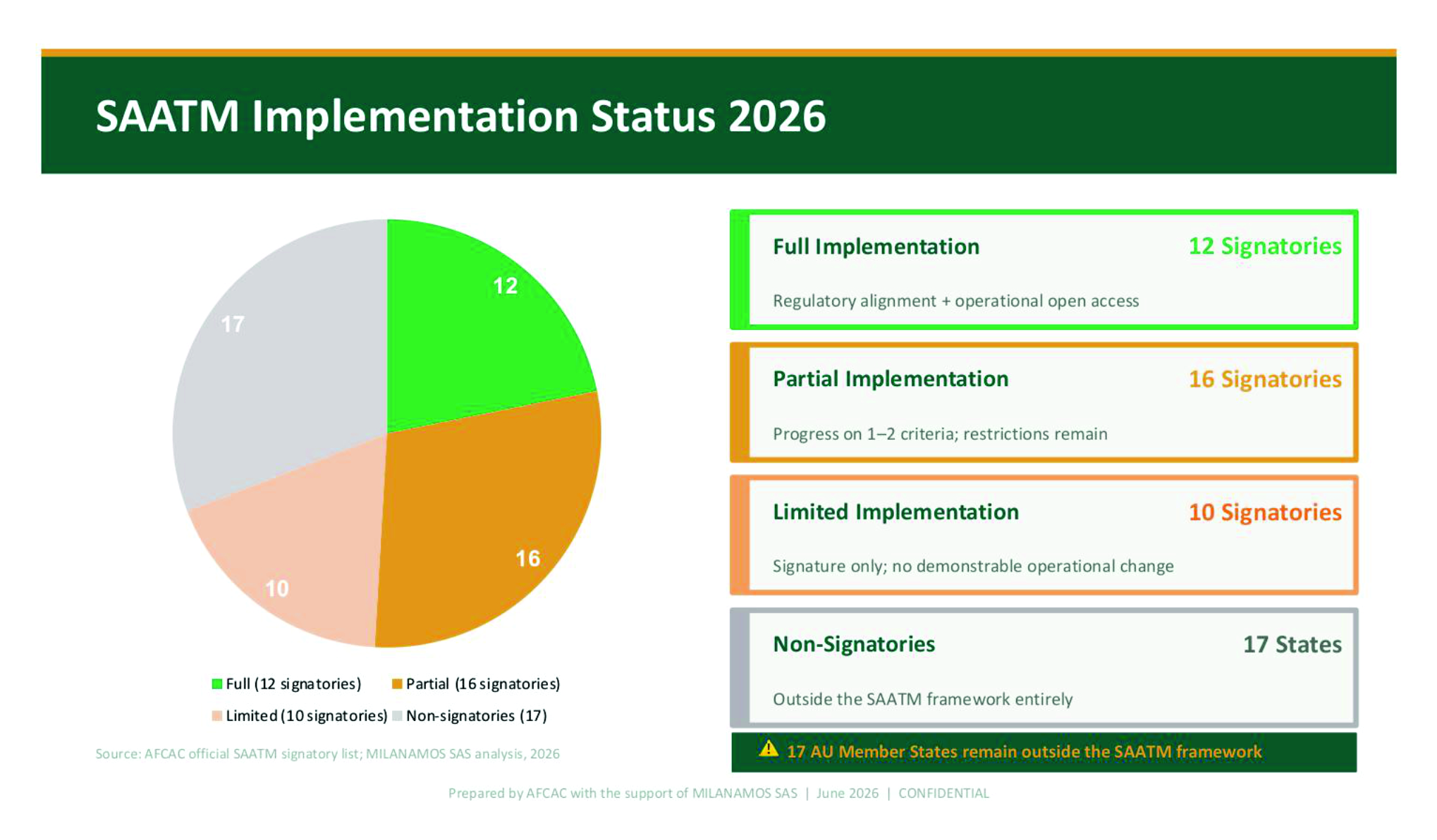
The enactment of the Single African Air Transport Market (SAATM) in 2018 has ensured that the continent has continued its drive towards air transport liberalisation. The uptick of activities around the SAATM would suggest that there is a continental recognition of the benefits of air transport liberalisation but many states continue to demur. Several studies by institutions and examples of implementation of air transport liberalisation in other regions of the world support this, but in Africa national interest has trumped the arguments.
SAATM implementation holds huge benefits for African airlines and the economic prosperity of the continent. In addition to its benefits in promoting trade, tourism and movement of persons, implementation of SAATM will generate employment, improve connectivity, lead to reduction of ticket prices according to research by IATA and other organisations.
Source: African Civil Aviation Commission (AFCAC)
Harmonisation of Policy and Regulations
Perhaps one of the most defining actions for the implementation of SAATM will be in the area of harmonising policies and regulations across the continent. There is agreement that the existence of different regulations is hampering the implementation of SAATM. It is said that in Africa, it is 54 national laws for aviation business. These different rules have fragmented policy-making on the continent, making it difficult for air operators on the continent to easily scale their operation and services. It is therefore not surprising that at the Inaugural AFCAC Air Transport Convention in Lome, June 2026 the Conference urged states to “Align bilateral and multilateral air services agreements with the principles of YD and SAATM to create a predictable, transparent regulatory environment.”
Speaking at IATA’s Wing Of Change Conference in Johannesburg, South Africa, Nigeria’s Aviation Minister, Mr. Festus Keyamo underscored the importance of harmonising policies and regulations when he called for “Policy harmonisation that advocates for the alignment of aviation policies and regulations across African countries to create a seamless and efficient air transport market.”
Increasingly the industry would like to see more benefits of liberalisation. A streamlined training licence regime, for instance, will ensure a more efficient movement of aviation personnel and manpower needs-balancing. A harmonised environment for Air Operators Certificate acquisition and operations across Africa become easier instead of the existence of 54 rules for setting up airline operations. It will also lead to more cross-border investment in air transport services. At the 18th Banjul Accord Group Plenary in Abuja in 2025, Mr. Stephen Musa of the AFCAC Secretariat listed “fragmented regulations” amongst other challenges facing the subregional group.
Furthermore, policy harmonisation in Africa will work to improve safety across African states. It will lead to a uniform consumer protection legislation that would ensure equal and proper treatment of passengers and remedies across jurisdictions.
Policy harmonisation will also reduce the price of tickets. The recent agreement by West African Heads of State to reduce aviation charges and fees by 25% across the subregion is a point of reference.
Obstacles to Policy Harmonisation
54 or 55 national regulations depending on who you ask is no doubt demanding. And for SAATM to be implemented more quickly, these discordant regulations need to be harmonised. But challenges abound.
Many countries do not wish to lose the independence of making their own regulations, for fear of losing sovereignty. Some of these regulations are aimed at either protecting the national carrier where this exists or the airline industry from domination. Yet, recent patterns in the aviation market in Africa suggests that protectionism has not stopped several of the continent’s national airlines from going under.
Others have also argued that the domestication of regulatory test is cumbersome and often takes long processes involving the parliament. But suffice it here to say that it may not really be about the cumbersomeness but of willingness; hence many are won’t to place the blame for non-implementation squarely at the doorsteps of technocrats, who many believe are advising governments wrongly.
What could be done?
To achieve faster policy harmonisation, states must abandon protectionism and the quest for sovereignty. One has suggested that the industry should strengthen the regional blocs to drive this harmonisation. It is equally important for harmonisation at the region-to-region levels to occur. States should also ensure all bilateral and multilateral air service agreements are YD-compliant. The last recommendation may equally be driven by SAATM-compliant states by insisting that air service agreement with non-SAATM compliant states should follow SAATM texts.
Final Thoughts
Africa’s air transport industry has continued to grow, albeit slower than desired. The implementation of SAATM in Africa will benefit the continent in many ways including improving air connectivity and economic development. However, to achieve any meaningful air transport liberalisation in Africa, air transport policies amongst states must be harmonised. This will lead to predictability in business transactions, increase investments and drive connectivity.
By Monday Ukoha