

Africa is increasingly recognised as one of the world’s most promising regions for Sustainable Aviation Fuel production. It is an observation repeated in conference halls, policy papers and investment forums across the continent.
It is also incomplete.
If current trends continue, Africa could become indispensable to the global SAF economy while capturing only a fraction of its economic value.
That would not be a failure of resources. It would be a failure of strategy.
For decades, Africa has entered global industries as the supplier of raw materials while higher value activities developed elsewhere. Coffee, cocoa, crude oil and critical minerals all tell a familiar story. The continent exports potential and imports value.
Sustainable Aviation Fuel presents Africa with a rare opportunity to rewrite that pattern before it becomes permanent.
Participation in the SAF value chain will not be determined by biomass availability alone. It will be determined by whether African countries deliberately position themselves to capture value across the entire supply chain, from project development and fuel production to certification, financing and technology. Climate policy may determine whether SAF is adopted.
Industrial policy will determine who benefits when it is.
This article examines the current SAF and Lower Carbon Aviation Fuel (LCAF) landscape in Africa, the barriers to production and distribution, the policy shifts required, and the case for regional collaboration. The argument is straightforward: without deliberate strategy, Africa will supply the world’s feedstock and lose the value that comes with it.
The Global Race Has Already Begun
The conversation around SAF has changed fundamentally over the past few years. The question is no longer whether SAF will become part of aviation’s future. The question is who will own the industries emerging around it.
Europe has created demand certainty through the ReFuelEU Aviation Regulation, giving investors confidence that a long-term market exists. The United States has accelerated domestic production through tax incentives such as the Clean Fuel Production Credit. Across Asia, governments are embedding SAF into wider industrial and energy strategies while investing heavily in emerging production pathways including Power-to-Liquid (PtL) fuels, a key category of Lower Carbon Aviation Fuels.
The global market is responding. According to industry forecasts, the SAF market is expected to grow from approximately USD 2.7 billion in 2025 to more than USD 40 billion by 2034, making it one of aviation’s fastest-growing industries.
The countries moving fastest are not necessarily those with the richest natural resources.
They are the ones that have reduced investment uncertainty.
Africa, meanwhile, possesses many of the ingredients required to become a significant SAF producer. Kenya’s Sustainable Aviation Fuel Business Implementation Study confirmed the technical feasibility of both HEFA (Hydro processed Esters and Fatty Acids) and Power-to-Liquid (PtL) pathways. Ethiopian Airlines continues exploring domestic SAF production opportunities. ICAO’s ACT-SAF programme is strengthening technical capacity across African states while development finance institutions have shown increasing interest in supporting early projects.
Yet commercial production remains negligible.
According to a 2025 joint assessment by IATA and Worley, Sub-Saharan Africa is expected to contribute only modest SAF production volumes despite possessing significant untapped feedstock potential. The report concludes that the primary constraints are no longer feedstock availability but infrastructure readiness, technology deployment and policy maturity.
Africa has demonstrated that it has the resources.
It has not yet demonstrated that it has built the conditions for an industry.
The Conversation Africa Is Having
Across Africa, discussions on SAF almost always begin with feedstocks. Agricultural residues. Municipal waste. Used cooking oil. Forestry by-products. Renewable electricity.
The inventory is impressive. Yet feedstocks have quietly become the centre of the conversation instead of the beginning of it.
Long before a litre of SAF reaches an aircraft, value has already been created. Value is generated when technologies are developed, projects are financed, facilities are engineered, sustainability claims are verified, fuel is certified, infrastructure is constructed and airlines negotiate long-term offtake agreements.
Feedstocks are only one stage of that value chain.
If Africa’s ambition stops at supplying biomass while higher-value activities mature elsewhere, the continent will participate in the SAF transition without capturing its greatest economic benefits.
History suggests we should take that possibility seriously.
The Real Constraint Is Not Feedstocks
One assumption continues to shape conversations across the continent. That Africa’s biggest challenge is finance. It is not. Africa’s biggest challenge is certainty.
Commercial SAF facilities require investments measured in hundreds of millions of dollars over project lifetimes extending well beyond twenty years.
Investors evaluate much more than feedstock availability. They examine permitting timelines, fiscal stability, sustainability standards, infrastructure readiness, regulatory credibility and long-term market demand.
Capital has never been afraid of geography.
It has always been afraid of uncertainty.

African airline, Kenya Airways is a major pioneer of the use of SAF
Over the past few years, my work with aviation stakeholders on CORSIA implementation and SAF readiness has revealed a consistent pattern. Airlines, regulators and operators understand that aviation is changing. They recognise that CORSIA Phase 2 is approaching and that international markets are steadily increasing demand for sustainable fuels. What many lack is not awareness. It is the institutional capacity, regulatory clarity and enabling environment to respond.
The gap between knowing what must be done and having the systems to do it has become one of Africa’s greatest competitive challenges.
Africa is not short of investor interest. It is short of investment conditions. Investors rarely choose the country with the most biomass. They choose the country where risk is easiest to understand.
That distinction should fundamentally reshape how Africa approaches SAF development.
Beyond certainty, the physical challenges of production and distribution are considerable. Most African airport fuel farms are not configured for SAF blending. Feedstock aggregation logistics are fragmented across vast territories with limited transport infrastructure. Quality assurance laboratories capable of certifying SAF to ASTM standards are scarce. These are solvable problems, but they require coordinated investment that only becomes viable once the enabling policy environment is in place. Certainty comes first; infrastructure follows.
The Value Africa Risks Losing
The greatest risk facing Africa is not missing the SAF transition. It is participating in it on someone else’s terms.
If Africa limits its ambition to producing biomass while others own the refineries, certification systems, engineering expertise, sustainability verification, intellectual property and financing structures, the continent will have entered the value chain without capturing much of its value.
Participation should never be confused with prosperity.
In 2025, airlines worldwide paid an estimated USD 2.9 billion premium for SAF, according to IATA. That premium represents far more than the cost of fuel. It reflects the value created through technology development, engineering, certification, financing, logistics, blending infrastructure and lifecycle emissions verification.
Every dollar generated after biomass leaves the farm represents value that can either remain in Africa or migrate elsewhere.
The countries that dominate the SAF economy will not necessarily be those with the greatest biomass resources. They will be those that make it easiest to transform biomass into bankable projects.
Africa’s competitive advantage should not be cheaper biomass. It should be becoming the easiest place in the emerging world to develop a bankable SAF project. That requires viewing SAF not simply as an environmental obligation but as an industrial opportunity capable of creating skilled employment, attracting long-term investment, strengthening energy security and building new technical capabilities across the continent.
The question is no longer whether Africa can produce Sustainable Aviation Fuel.
The question is whether Africa will own enough of the industry to benefit from producing it.
From Potential to Participation
The next phase of Africa’s SAF journey requires a fundamentally different conversation. Not more MoUs. Not more feasibility studies where feasibility has already been demonstrated. Not more roadmaps that end where implementation begins.
The first priority is policy certainty. Stable legislation, transparent sustainability frameworks and fiscal incentives that survive political cycles are not administrative details. They are investment signals.
The second is infrastructure. Airport fuel farms, blending capability, storage systems, quality assurance procedures and distribution networks must evolve alongside future SAF deployment rather than react to it years later.
The third is institutional capability. Regulators, airports, fuel suppliers and airlines require expertise in lifecycle emissions accounting, sustainability certification, project finance, CORSIA implementation and environmental compliance. Human capital is becoming just as strategically important as physical infrastructure.
The fourth is market certainty. SAF currently costs significantly more than conventional jet fuel. Without predictable demand, long-term offtake agreements or supportive government policies, producers struggle to justify investment. Creating reliable demand is inseparable from building reliable supply.
The fifth is regional cooperation. Few African countries possess sufficient domestic demand, infrastructure and investment capacity to independently sustain globally competitive SAF industries. Harmonised regulations, shared certification systems, coordinated infrastructure planning, regional production hubs and aggregated demand create markets capable of attracting commercial investment at scale.
Industrial clusters attract capital. Fragmented markets compete for it.
Can Africa Go It Alone?
No. Nor should it try.
The scale of investment, technology and expertise required to establish a competitive SAF industry makes regional collaboration an economic necessity rather than a political aspiration. That means regional certification centres, shared research infrastructure, cross-border logistics coordination and common sustainability standards. These are not diplomatic ambitions. They are the foundations of a bankable African SAF industry.
Africa already has platforms worth building upon. ICAO’s ACT-SAF programme is supporting technical assistance across the continent. The CORSIA Buddy Partnership has demonstrated how knowledge sharing between states can accelerate regulatory readiness. AFCAC and AFRAA provide frameworks for coordinating policy and aligning airline strategy.
The same cooperative model must now extend beyond compliance toward industrial development. The objective should not be twelve countries building twelve separate industries.
It should be Africa building one competitive ecosystem.
A Different Definition of Success
Africa does not need every country to build a refinery. Some countries will specialise in biomass production. Others will become centres of engineering excellence, sustainability certification, project finance, lifecycle emissions accounting or carbon markets.
Success will not come from every country doing everything. It will come from every country deliberately owning a higher-value part of the chain.
Success should not be measured by how much biomass Africa exports. It should be measured by how much value Africa retains.
Africa’s greatest export in the SAF economy should not be biomass. It should be confidence. Confidence that projects can secure permits efficiently. Confidence that regulations remain stable. Confidence that investments are protected. Confidence that African institutions can deliver.
Conclusion
Africa is in danger of winning the wrong race.
The continent possesses many of the ingredients needed to become a significant player in the global Sustainable Aviation Fuel economy. Resources. Growing policy momentum. Improving regulatory awareness. Increasing international interest.
But resources alone have never guaranteed industrial leadership.
The countries that define the future SAF economy will not simply be those with the richest biomass resources. They will be those that build the strongest institutions, reduce investment uncertainty and deliberately position themselves higher up the value chain.
The opportunity before Africa is no longer simply to produce SAF. It is to build an industry around it. The choices being made today will shape aviation’s supply chains for decades. Africa still has time to influence those choices. But the window is narrowing.
The future of African aviation will not be determined by the resources beneath our feet. It will be determined by the choices made around our boardroom tables.
Before someone else makes them for us.
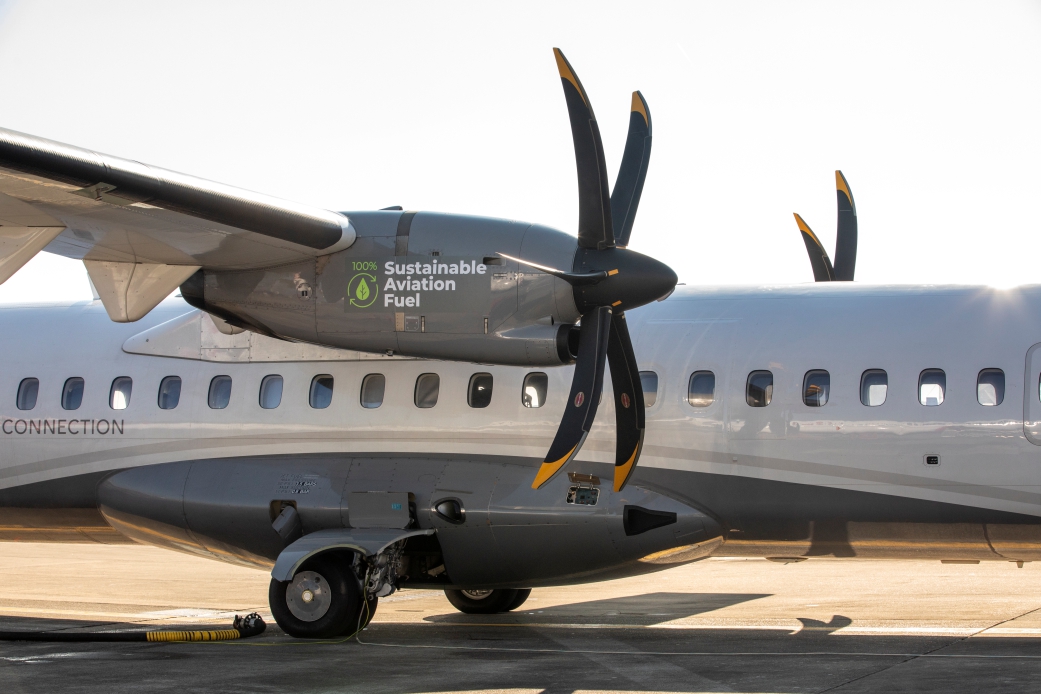
ATR 72-600 SAF powered aircraft
About the Author
Shereen Onyango is the CEO of AngaSafi Africa, a sustainability consultancy supporting aviation operators across Africa on CORSIA compliance, SAF regulatory readiness and emissions reporting. She holds an MSc in Sustainable Air Transport Management from ITAérea Aeronautical Business School and a BSc in Statistics from the University of Nairobi. With over ten years of operational experience in the aviation industry, her work sits at the intersection of aviation operations, climate policy and sustainable fuel systems. She is an IATA Certified Aviation Internal Auditor and a recognised voice on African aviation decarbonisation.