

Airports Council International (ACI) World has released “the 2025 Edition of its World Airport Traffic Dataset, the industry’s most comprehensive and authoritative resource for global airport rankings. “The new data confirms “the world’s busiest airports in 2024 across three major categories: passenger traffic, air cargo volumes, and aircraft movements.”
According to ACI World, “built from over 2,800 airports across 185+ countries and territories, the dataset provides a comprehensive snapshot of global air transport demand and activity over the past year.”
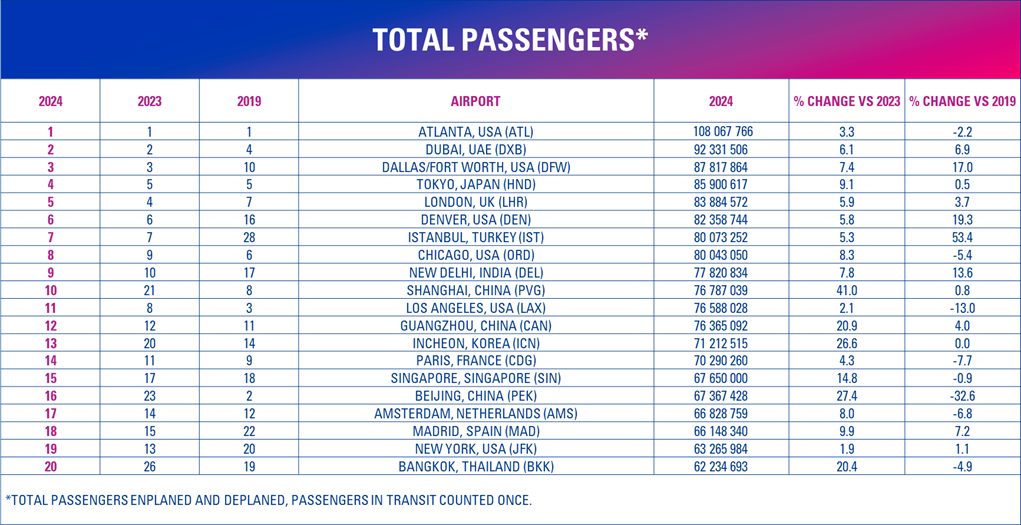
On the Passenger Traffic Highlights, the report revealed that: “Global passenger traffic hit a new high in 2024, surpassing 9.4 billion travellers — up 8.4% from 2023 and 2.7% above pre-pandemic levels (2019).” Also, “the top 20 airports alone processed 1.54 billion passengers, capturing 16% of global traffic.”
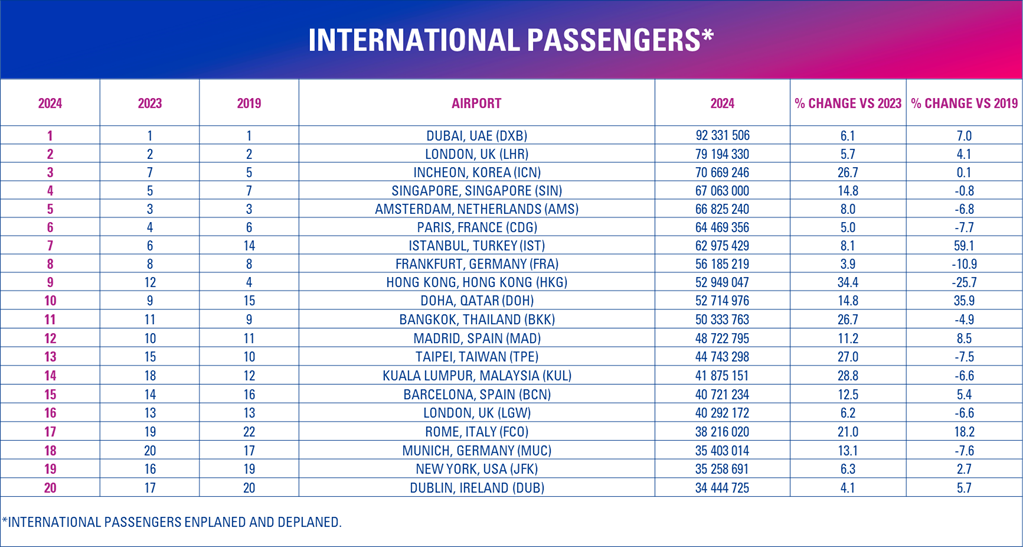
ACI says: “The United States contributed six airports to the top 20, mostly dominated by domestic traffic—except for JFK, where international passengers made up 56%.”
On the Cargo Traffic Highlights, the dataset revealed that: “Air cargo rebounded with close to 127 million metric tonnes handled in 2024—up 9.9% year-over-year and 4.1% over 2019” and “the top 20 cargo hubs moved 52.2 million tonnes, up 9% from 2023 and 10.8% above pre-pandemic levels.”
According to ACI World, key drivers of growth included:
- Maritime route volatility, which led shippers to seek more reliable and faster alternatives via air.
- E-commerce acceleration, driven by consumer demand for faster fulfillment across borders.
- Falling jet fuel costs, which lowered operating expenses and improved air freight competitiveness.

On Aircraft Movement Highlights, the dataset revealed that: “Aircraft movements topped 100.6 million globally in 2024— an increase of 3.9% year-over-year, reaching 96.8% of 2019 levels.”
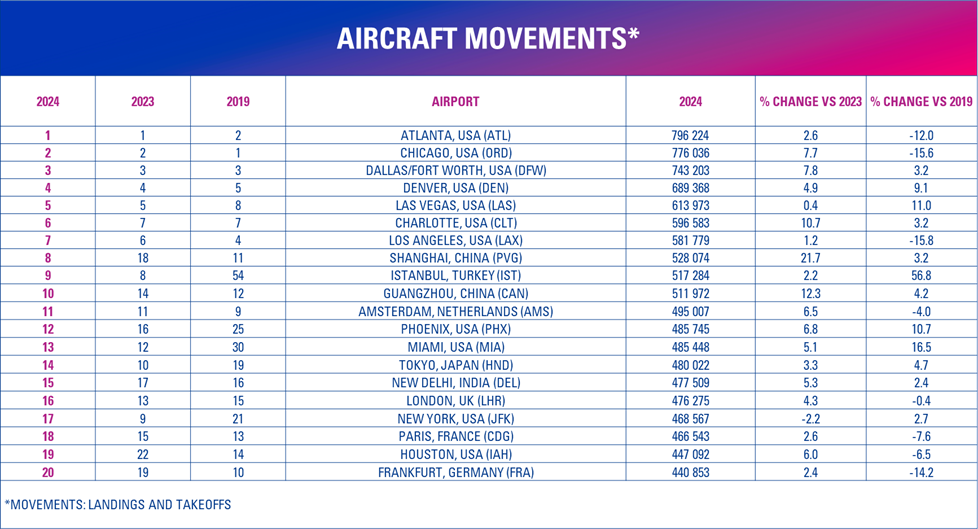
ACI World says “The top 20 airports saw 11.08 million movements, up 5.4% year-over-year.”
ACI World Director General Justin Erbacci said: “These rankings reflect the scale of global aviation and the resilience of the industry that continues to grow, despite the complex global environment. In these times of constant change and uncertainty, reliable data like this is necessary to help airports navigate through the increasing headwinds. Our mission is to empower airports with data and intelligence like this report – as well with the tools, support and advocacy they need to thrive in this dynamic environment.”