

By: Monday Ukoha
Rising Air Cargo Demand
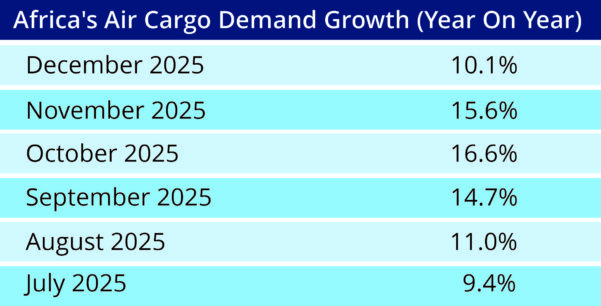
The International Air Transport Association (IATA) in its December 2025 air cargo demand report noted that African air cargo demand grew 10.1% over the same period in 2024. On a full year basis, IATA said African air cargo demand grew by 6% growth in 2025 above the global rate of 3.4%. “African airlines saw 6.0% year-on-year demand growth for air cargo in 2025. Capacity increased by 7.8% year-on-year.
December year-on-year demand increased by 10.1%, the highest of all regions, and capacity increased 9.8%.” The Association further noted that this was the sixth consecutive month of growth for the sector in Africa. Africa’s air cargo demand has seen an upward trajectory even if the continent continues to punch below its weight.
E-Commerce Has Huge Prospects in Africa
Globally, air cargo growth has been helped in no small measure by e-commerce. It has been estimated that about 80% of e-commerce is carried as air cargo. Nevertheless, e-commerce continues to be an area with huge latent growth potential in Africa. One of the aftereffects of COVID-19 pandemic has been the increasing rate of online purchases across all regions. Helped by increasing internet penetration on the continent, many people on the continent have embraced e-commerce especially in urban centers of the continent.
Whilst Africa still lags behind other regions in e-commerce, there is a general agreement that the e-commerce market in Africa is huge and remains largely untapped.
In their World Air Cargo Forecast 2024-2043, aircraft manufacturer Boeing noted: “Africa imports a diverse array of industrial and manufactured commodities from East Asia. African e-commerce is boosting demand for Asia-sourced consumer products and has huge potential to expand. Today, the African e-commerce market is largely untapped. Although nearly one-fifth of the world’s population lives in Africa, the continent accounts for less than half a percent of global e-commerce sales. African e-commerce is expected to grow at double-digit rates in coming years to meet this demand, driving continued air cargo growth.”
Sanjeev Gadhia, CEO of Astral Aviation, one of the leading cargo airlines in Africa is reported to have said that though Africa is behind the global trajectory of e-commerce growth, he sees Africa catching up and projects that the first major boom for e-commerce in Africa will be around 2027. In terms of monetary value, some estimates see between USD40 Billion and USD75 Billion market in the short term. African countries at the fore front of e-commerce include South Africa, Nigeria, Kenya and Egypt.
Anticipating this growth, ET, Africa’s largest airline, has established a state-of-the-art e-commerce logistics centre in Addis Ababa, Ethiopia. At the unveiling of the facility, ET Group CEO Mr. Mesfin Tasew said: “We have implemented high-end technologies in the infrastructure that revolutionize the way goods are transported and delivered in the e-commerce industry in Africa. Through this facility, Ethiopian Airlines paves the way for development of e-commerce services in Ethiopia and the African continent.”
Drivers of E-Commerce In Africa
Internet connectivity is the bedrock of digital trade. It follows that for e-commerce to grow in Africa, there needs to be quantum improvement in internet speed, quality and availability. The International Telecommunication Union, in a comparative assessment of internet penetration across regions notes: “Looking at the regions, in the Commonwealth of Independent States (CIS), Europe, and the Americas, between 88 and 93 per cent of the population use the Internet. In Asia-Pacific and the Arab States regions, Internet use is at 77 and 70 per cent, respectively, which is in line with the global average. By contrast, the average figure for Internet use for Africa is just 36 per cent.” Comparatively, the growing but relatively low internet penetration on the continent portends good opportunity for e-commerce growth in Africa. The global average was 67%, which implies more opportunities for internet use in Africa and consequently e-commerce adoption.
Demographics Favour Africa
In addition to the above, an expanding middle-class population, a large youth population – Africa is reputed to have the youngest population of all continents – and the proliferation of local payment options are all poised to propel the rise of e-commerce on the continent.
How Africa Can Grow Its Cargo And E-Commerce Sectors
- Expanded Production And Value Addition
Africa’s exports currently still consist mainly of primary and agricultural goods with little or no value addition. Writing in a concept note, the African Economic Research Consortium noted: “Although there has been growth in exports and value over time, there has been a declining African export share in global value chains, pointing to Africa’s reduced competitiveness in these sub-sectors.” The report notes further that “Africa’s significant agricultural and natural resources are being exploited and exported mostly in their raw form, with little or no value added to commodity exports.”
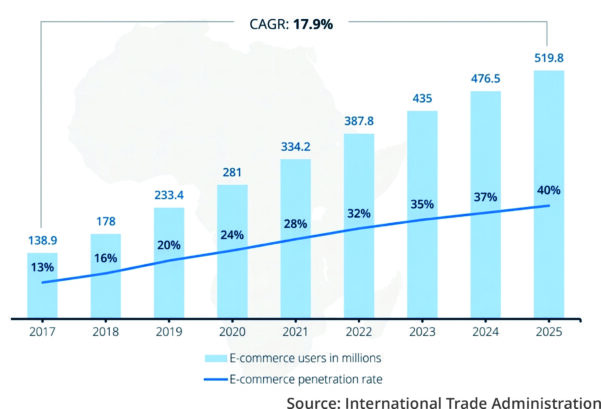
E-commerce Penetration To Reach 40% By 2025
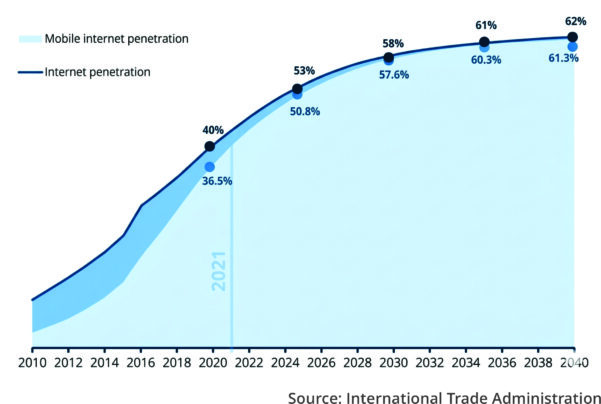
Estimated Mobile Internet & Total Internet Penetration
To be able to leverage the emerging power of e-commerce and its potential impact for the African air cargo sector, African economies must expand their production base to wholly transform produce or add value to them. Expanding the production base will in turn give considerable scope for intra Africa trade in finished or semi-finished goods. Equally important, whereas import bound demand has driven cargo growth thus far in Africa, the need for the continent to stimulate more air cargo on the domestic markets, especially export cargo is paramount and would lead to more growth of the sector.
- More Intra Africa Trade
Furthermore, for Africa to grow its share of world air cargo, there is a very urgent need for increased intra Africa trade. The current composition of Africa’s e-trade needs to be rebalanced: the component of Africa’s imports includes electronics, household materials, while the domestic e-commerce more often than not are majorly food and redistribution of imported goods.
Increasing African Cargo Airlines Capacity
The new e-commerce regime foresees more participation for African cargo airlines in terms of increasing capacity in the market, driving down freight rates, and anticipating emerging requirements for environmental obligations for carbon reduction for their fleet. African cargo airlines have risen to the occasion. In 2018, one of Africa’s leading cargo airlines, Nigeria-based Allied Air took delivery of its first Boeing 737-800 converted freighter. The airline noted then that the aircraft “is the youngest 737-800 in the world that has been converted to-date.” In 2024, the same airline would add another Boeing 737-800SP to its fleet. Kenya-based Astral Aviation is reported to have an ambition to reduce its carbon footprint by 5% by 2030. ET has also announced lease agreement with Aercap for two (2) Boeing 777 cargo freighters.
Infrastructure Requirements
Counties across Africa are involved in airport infrastructure improvements. From Cairo to the Cape and Lagos to Addis, Africa is witnessing this shift in airport infrastructure modernization investment. This should continue.
E-Commerce And Air Cargo Opportunities
E-commerce and air cargo are mutually reinforcing e-commerce rides on air cargo, and air cargo in return is boosted by e-commerce. For Africa, opportunities exist to further boost the growth of air cargo through an efficient e-commerce subset. Internet penetration is bound to grow as population grows and technologies improve including payment infrastructure to drive more e-commerce. Africa’s GDP is equally primed to be one of the fastest growing for the foreseeable future providing an enabling base for participation of more Africans in e-commerce.
In the air cargo market, the continent is experiencing improved connectivity thanks to the implementation of the Single African Air Transport Market (SAATM). SAATM is creating, in particular, 5th freedom traffic which connects many thin African markets with passenger and cargo traffic. Equally important is the full stimulative impact of the African Continental Free Trade Area (AfCFTA) which, though has not yet been fully brought to bear on the cargo segment, holds the potential to do so.
However, the necessity for Africans to trade more with themselves has never been more compelling. This is a potential growth area for the industry. In addition, African economies must be stimulated to produce, process and add value without which the pool of products available for exchange will remain negligible.
Infrastructure in support of air cargo, improvements in the custom clearing environment and harmonization of regulations will add a further impetus to drive e-commerce and air cargo on the continent. Increased production for export, investing in value addition processes and regulatory harmonisation will also boost the air cargo sector in Africa.
The challenge before Africa is to stimulate its economies in such a way that more young people can participate in trade, commerce and industry. Capital accumulation in this regard is necessary. Equally necessary is intra Africa investment. The Secretary General of AfCFTA, His Excellency Wamkele Mene puts intra Africa investment at just 4%. This also has to change. Cross African investment will scale the needed production to drive more African participation in the cargo ecosystem. Without production, it suffices to say that Africa’s share of global air cargo will continue to lag global counterparts. And so also ‘the near-empty return leg’ syndrome in Africa’s air cargo ecosystem.
In all, there is no question that Africa’s air cargo and e-commerce are poised for growth, but the hard work is to ensure more African products are involved in that exchange to improve the lives of people on the continent. Otherwise, the growth will just be another dataset.