
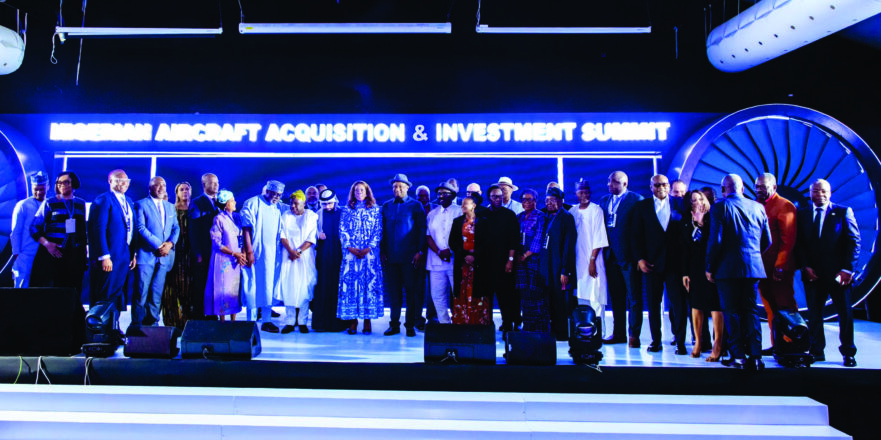
Nigeria’s Minister of Aviation and Aerospace Development, Festus Keyamo SAN has stated that “aircraft acquisition sits at the intersection of these three pillars of capital, confidence and capacity.” The Honourable Minister stated this is in his keynote address at the Nigerian Aircraft Acquisition and Investment Summit (NAAIS) held in Lagos, Nigeria.
Keyamo said: “Without modern and fuel-efficient fleets, Nigerian airlines cannot compete sustainably. Without financing certainty, they cannot scale. Without institutional confidence, global lessors and lenders will remain cautious; without local maintenance capacity, asset productivity suffers. Without skilled people, growth cannot be sustained.”
The Honourable Minister said Nigeria is shifting focus from treating aircraft acquisition as a routine transaction to a broader economic strategy. He stated that “we are here not merely to discuss aircraft acquisition as a transactional issue, but to unlock something far more strategic and far more consequential: capital, confidence, and capacity, the three pillars upon which any globally competitive aviation industry must stand.”
The Minister highlighted that access to affordable aircraft financing has long constrained Nigerian airlines, limiting fleet renewal and route expansion. He stressed that the current administration now considers the issue a national priority. He noted that “for decades, access to affordable and dependable aircraft financing has remained one of the most significant constraints for Nigerian operators. It has limited fleet renewal, constrained route development, weakened competitiveness, and increased operating costs.”
And to address the issue of financing, the Federal Government of Nigeria has strengthened its implementation of the Cape Town Convention and introduced policies such as the Irrevocable De-Registration and Export Request Authorisation (IDERA) which is aimed at improving aircraft leasing processes and reducing operational costs.
On infrastructure and capacity development, the Minister pointed to ongoing investments in airport modernisation, investments and development of local maintenance facilities, fleet modernisation, and partnerships for training aviation personnel to close the gap between Nigeria’s aviation potential and its realised aviation capacity.
Reaffirming Nigeria’s readiness for global partnerships, Keyamo called on investors, lessors, and development partners to support the country’s aviation goals. He stressed that “Nigeria is ready. We have strengthened our compliance architecture. We have improved creditor assurance. We have demonstrated progress on revenue repatriation. We are supporting local MRO development. We are investing in digital and institutional reform. We are pursuing cargo modernisation. And we are doing so in one of Africa’s most consequential aviation markets.”
The Minister added that “what we seek now is partnership; partnership that unlocks affordable aircraft financing; partnership that supports fleet renewal and expansion; partnership that strengthens maintenance, training and technical capability; partnership that helps Nigeria become not just a market for aviation, but a platform for aviation growth across Africa.”
Keyamo concluded that “Nigeria stands today at the threshold of a new aviation era, an era in which capital is more confident, institutions are more credible, and capacity is being deliberately built. Let us seize this moment together. Let us unlock the full potential of Nigeria’s aviation industry. Let us build an ecosystem that is investable, competitive, sustainable and globally relevant.”
The summit brought together key stakeholders, including financiers, aircraft manufacturers, and airline operators, to explore pathways for sustainable growth and fleet expansion in Nigeria’s aviation sector.