
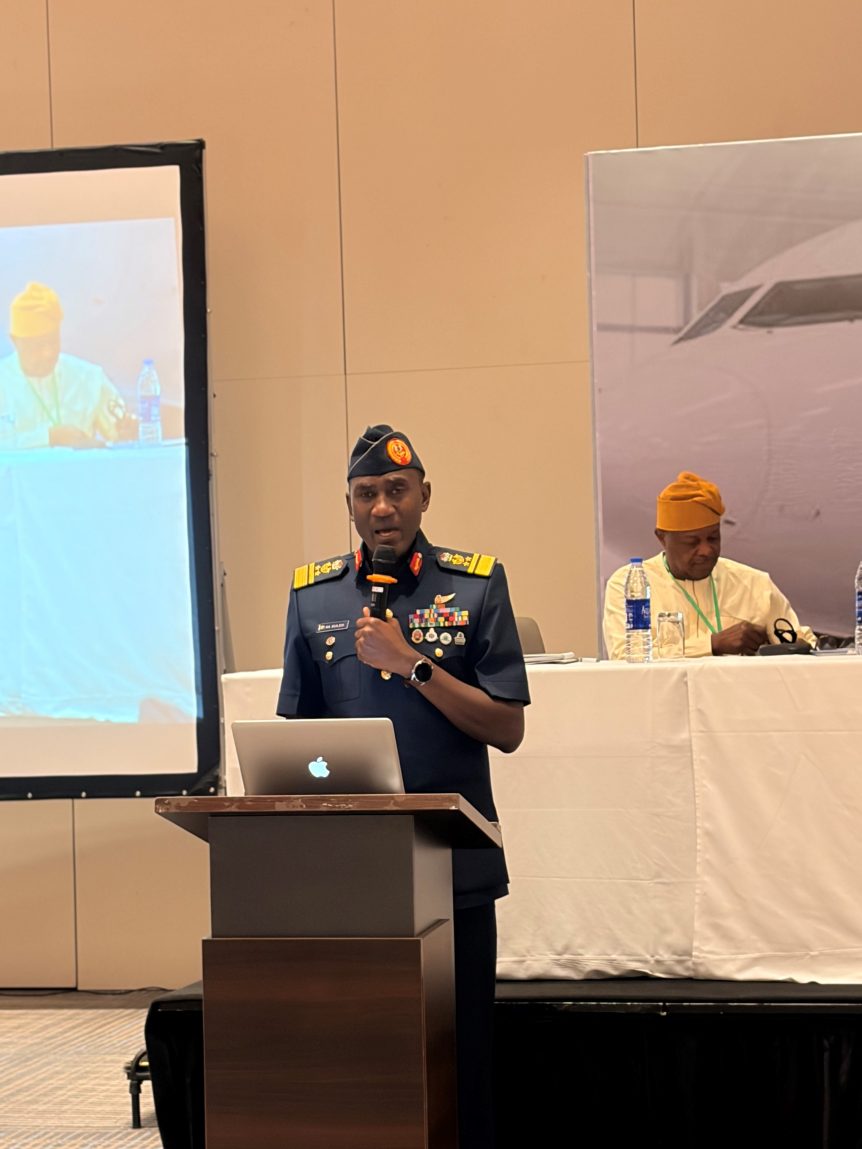
Air Officer Commanding, Logistics Command of the Nigerian Air Force, Air Vice Marshal A.A. Suleh has outlined seven strategic imperatives to reposition Nigeria’s aviation industry, stressing that sustainable growth can be built on engineering excellence, long-term planning, investment, innovation and collaboration rather than short-term interventions.
Speaking at the Institute of Nigerian Aeronautical Engineers (INAE) International Conference/Exhibition, Fellowship Conferment 2026 which focused on the theme “Aeronautical Engineering and National Development: Repositioning the Nigerian Aviation Industry,” AVM Suleh described aviation as “no longer merely a means of transportation; it is a strategic national capability that supports trade, tourism, defence, emergency response, agriculture, technological development, industrialisation, among others. And at the centre of this is aeronautical engineering, a means that makes flights safe, reliable, efficient, and sustainable.”
According to AVM Suleh, there are seven strategic imperatives to reposition the Nigerian aviation industry. The first one is a Coherent National Aviation and Aerospace Industry Strategy, he stated that “Nigeria requires a long-term aviation and aerospace industrial strategy that transcends annual budgets and changes in administration. Such a strategy should identify the capabilities Nigeria intends to develop over the next 10 to 30 years. It should define national priorities in aircraft maintenance, component repair, unmanned systems, avionics, ground support equipment, composite materials, simulation, training, and research and development.”
Second strategy is Development of a competitive Maintenance, Repair and Overhaul Ecosystem, AVM Suleh remarked that “Nigeria must treat maintenance, repair, and overhaul as a strategic industry. A strong domestic MRO ecosystem will reduce aircraft downtime, retain expenditure within the country, create skilled jobs, and attract maintenance businesses from other African countries.”
On Strengthening Safety, Airworthiness and Quality Assurance, AVM Suleh affirmed that “Safety must remain the foundation of all aviation development.” It should be ensured that local production and maintenance never compromise safety standards, regulatory compliance or engineering quality. AVM Sule stated that “Safe maintenance is not an administrative body, it is an operational environment.”
The fourth strategy is Human Capital Development and Professional Retention, AVM Suleh said that “Nigeria must develop a deliberate pipeline for producing aeronautical engineers, aircraft maintenance engineers, avionics specialists, technicians, safety professionals, inspectors, data analysts, and aviation managers. While professional mobility cannot be prevented, better working conditions, clearer career pathways, continuous training, and access to modern equipment and competitive incentives can improve retention.”
Addressing Research, Innovation and Indigenous Manufacturing, AVM Suleh declared that “Nigeria must move from being predominantly a consumer aviation technology nation to becoming a developer and producer of selected aviation products and services. Our immediate focus should be on realistic and capability-driven actions. We should prioritise areas where local production can be achieved safely and economically.”
Speaking on Digital Transformation and Aviation Maintenance and Logistics, AVM Suleh disclosed that “The future of aviation engineering is digital. A digital maintenance and logistics system improves visibility, accountability, and decision-making. It enables operators to know the conditions, location, history, and maintenance status of assets in near real-time.”
On Sustainable Financing and Partnerships, AVM Suleh noted that “Aviation development requires substantial and sustained capital investment. Government funding alone may not be sufficient to achieve all our national objectives.” This can be achieved by leveraging on public-private partnerships, research grants, technology transfer, infrastructure financing and long-term investment mechanisms to support aviation development.
AVM Suleh concluded that “the Nigerian aviation industry will not be repositioned by aspirations alone. It will be repositioned through engineering discipline, sound policy, investment, collaboration and consistent implementation.” He noted further that “Nigeria possesses the talent, market, institutions and strategic need and we can do it. What is required is unity of purpose, continuity of policy and the courage to move from discussions to implementation.”